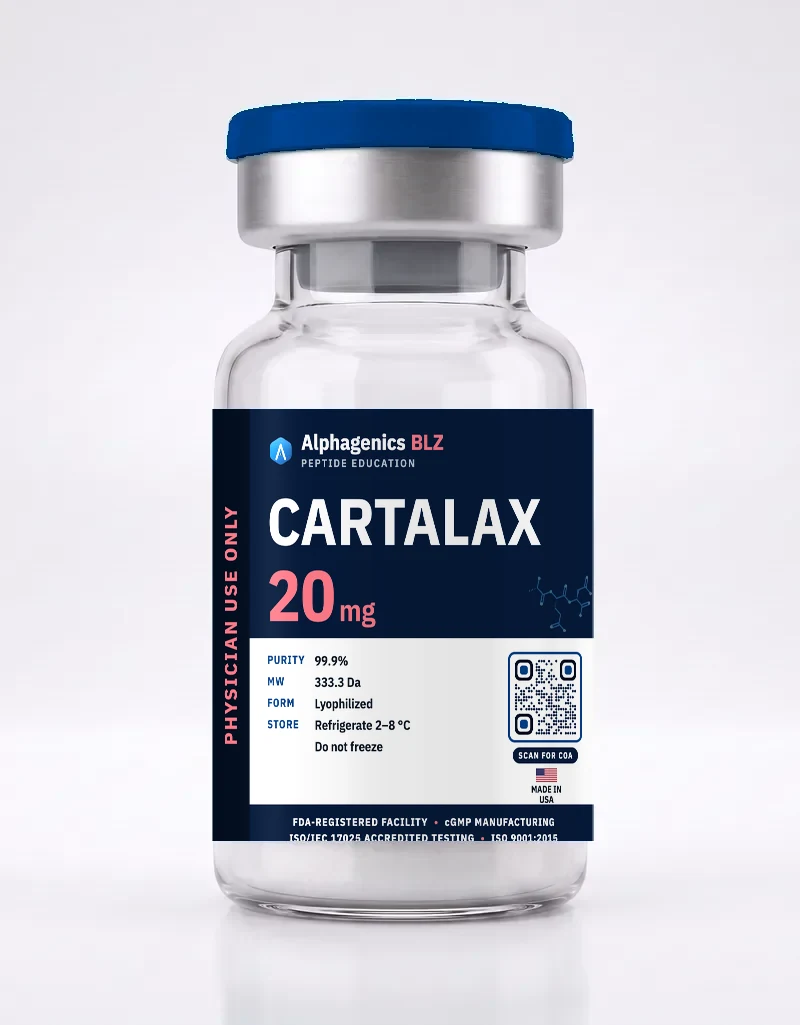
Cartalax
Ala-Glu-Asp · AED · T-31 · Kartalax
Synthetic tripeptide (short peptide bioregulator)
About Cartalax
Cartalax (Ala-Glu-Asp, AED) is a synthetic tripeptide developed by Professor Vladimir Khavinson's group at the Saint Petersburg Institute of Bioregulation and Gerontology, as part of its series of short peptide bioregulators.
It has been studied mainly in cultures of chondrocytes, mesenchymal stem cells and aged skin fibroblasts, where it has been associated with changes in markers of differentiation, inflammation and cellular aging, and in rats in relation to kidney function. The evidence comes largely from a single research group and is mostly preclinical; no controlled clinical trials were found published in PubMed.
Structure and sequence
Sequence

Five findings from studies
Summary of results reported in the scientific literature. Each finding describes what was observed in the cited study, in its specific population and conditions; it does not constitute a therapeutic indication.
-
In vitro
In human mesenchymal stem cells during replicative aging, the AED peptide has shown activation of gene expression and protein synthesis of chondrogenic differentiation markers (SOX9, aggrecan, type II collagen and COMP); a cartilage polypeptide complex showed the same effect at a tenfold higher concentration.
Myakisheva SN et al. Adv Gerontol. 2023;36:383-390 · PMID 37782646 -
In vitro
In chondrocytes with an aging-associated secretory phenotype (more p16, p21, p53, TNF-α and IL-1α, and less sirtuin-1), the AED peptide and a cartilage polypeptide complex have been associated with normalized synthesis of these molecules.
Myakisheva SN et al. Adv Gerontol. 2023;36:234-238 · PMID 37356100 -
In vitro
In human skin fibroblasts during replicative aging, the AED peptide has shown activation of the synthesis of sirtuin-1, sirtuin-6 and type I collagen.
Fridman NV et al. Bull Exp Biol Med. 2020;170:154-157 · PMID 33231794 -
In vitro
In aged skin fibroblasts in culture, AED, together with other short peptides (KE, KED and AEDG), has been associated with lower MMP-9 synthesis and higher Ki-67 and CD98hc expression; AED and AEDG were also associated with suppression of caspase-dependent apoptosis.
Lin'kova NS et al. Bull Exp Biol Med. 2016;161:175-178 · PMID 27259496 -
Preclinical
In old rats, the AED peptide has been associated with increased diuresis and with lower urine protein concentration and excretion; the authors described higher antioxidant enzyme activity in kidney tissue and observed no signs of nephrotoxicity.
Zamorskii II et al. Adv Gerontol. 2018;31:498-504 · PMID 30607912
Frequently asked questions
What is Cartalax?
Cartalax (Ala-Glu-Asp, AED) is a synthetic tripeptide developed by Professor Vladimir Khavinson's group at the Saint Petersburg Institute of Bioregulation and Gerontology, as part of its series of short peptide bioregulators. It has been studied mainly in cultures of chondrocytes, mesenchymal stem cells and aged skin fibroblasts, where it has been associated with changes in markers of differentiation, inflammation and cellular aging, and in rats in relation to kidney function.
What target or receptor does Cartalax act on?
Not established; regulation of gene expression has been proposed (proposed)
What is the half-life of Cartalax?
Not established in humans
What have published studies observed about Cartalax?
In human mesenchymal stem cells during replicative aging, the AED peptide has shown activation of gene expression and protein synthesis of chondrogenic differentiation markers (SOX9, aggrecan, type II collagen and COMP); a cartilage polypeptide complex showed the same effect at a tenfold higher concentration. (Myakisheva SN et al. Adv Gerontol. 2023;36:383-390, PMID 37782646) In chondrocytes with an aging-associated secretory phenotype (more p16, p21, p53, TNF-α and IL-1α, and less sirtuin-1), the AED peptide and a cartilage polypeptide complex have been associated with normalized synthesis of these molecules. (Myakisheva SN et al. Adv Gerontol. 2023;36:234-238, PMID 37356100)
How is Cartalax stored?
Refrigerate at 2–8 °C, do not freeze. Protect from light and moisture, unopened and once reconstituted.
What sizes is Cartalax available in?
10mg · 20mg


