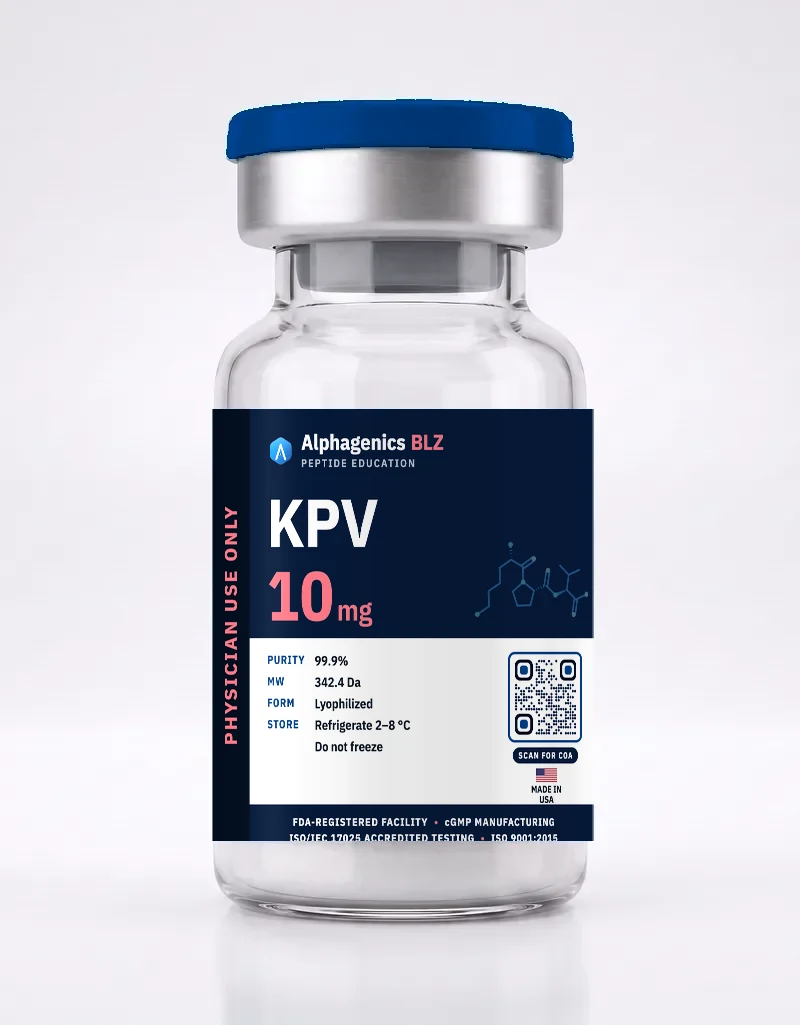
KPV
Lys-Pro-Val · α-MSH (11-13) · Lysyl-prolyl-valine
C-terminal tripeptide of α-MSH (α-MSH 11-13)
About KPV
KPV is the tripeptide Lys-Pro-Val, which corresponds to amino acids 11-13 at the C-terminal end of alpha-melanocyte-stimulating hormone (α-MSH).
It has been studied as an anti-inflammatory alternative to α-MSH because, according to the literature, it retains the hormone's anti-inflammatory effect without its pigmentary action. Most of the research comes from cell cultures and murine models of colitis, in which its entry into cells through the PepT1 peptide transporter and the inhibition of NF-κB inflammatory signaling have been described; its signaling in human keratinocytes has also been studied. No published clinical trials of KPV in humans were found.
Structure and sequence
Sequence

Five findings from studies
Summary of results reported in the scientific literature. Each finding describes what was observed in the cited study, in its specific population and conditions; it does not constitute a therapeutic indication.
-
Preclinical
In human intestinal epithelial cells and T cells, nanomolar concentrations of KPV have been shown to inhibit NF-κB and MAP kinase activation and to reduce pro-inflammatory cytokine secretion, with entry into cells through the PepT1 transporter; in mice with DSS- or TNBS-induced colitis, KPV in drinking water has been associated with less colitis and lower pro-inflammatory cytokine expression.
Dalmasso G et al. Gastroenterology. 2008;134:166-178 · PMID 18061177 -
Preclinical
In two murine models of colitis (DSS and CD45RBhi T-cell transfer), KPV has been associated with earlier recovery of body weight, fewer inflammatory infiltrates and lower myeloperoxidase activity in the colon; in mice with a non-functional MC1R, all treated animals survived DSS colitis, suggesting an effect at least partly independent of MC1R.
Kannengiesser K et al. Inflamm Bowel Dis. 2008;14:324-331 · PMID 18092346 -
Preclinical
In mice with DSS-induced colitis, KPV loaded into nanoparticles and encapsulated in a colon-targeted hydrogel has been associated with protection against inflammatory and histological parameters, with therapeutic efficacy similar to that of KPV in free solution at a 12,000-fold lower concentration.
Laroui H et al. Gastroenterology. 2010;138:843-853 · PMID 19909746 -
In vitro
In human keratinocytes (HaCaT line and normal keratinocytes), KPV did not raise cyclic AMP; rapid increases in intracellular calcium were observed (in the HaCaT line, only in the presence of an adenosine agonist that inhibits the cyclic AMP pathway), and in cells transfected with the MC1R receptor KPV also raised intracellular calcium.
Elliott RJ et al. J Invest Dermatol. 2004;122:1010-1019 · PMID 15102092 -
Review
A review of α-MSH and its related tripeptides describes KPV as retaining the hormone's anti-inflammatory effect without its pigmentary action, and considers it a candidate for future research in inflammatory skin and bowel disease, fibrosis, lung and ocular inflammation and arthritis.
Brzoska T et al. Endocr Rev. 2008;29:581-602 · PMID 18612139
Frequently asked questions
What is KPV?
KPV is the tripeptide Lys-Pro-Val, which corresponds to amino acids 11-13 at the C-terminal end of alpha-melanocyte-stimulating hormone (α-MSH). It has been studied as an anti-inflammatory alternative to α-MSH because, according to the literature, it retains the hormone's anti-inflammatory effect without its pigmentary action.
What target or receptor does KPV act on?
PepT1 transporter (cellular uptake); NF-κB pathway (proposed)
What is the half-life of KPV?
Not established in humans
What have published studies observed about KPV?
In human intestinal epithelial cells and T cells, nanomolar concentrations of KPV have been shown to inhibit NF-κB and MAP kinase activation and to reduce pro-inflammatory cytokine secretion, with entry into cells through the PepT1 transporter; in mice with DSS- or TNBS-induced colitis, KPV in drinking water has been associated with less colitis and lower pro-inflammatory cytokine expression. (Dalmasso G et al. Gastroenterology. 2008;134:166-178, PMID 18061177) In two murine models of colitis (DSS and CD45RBhi T-cell transfer), KPV has been associated with earlier recovery of body weight, fewer inflammatory infiltrates and lower myeloperoxidase activity in the colon; in mice with a non-functional MC1R, all treated animals survived DSS colitis, suggesting an effect at least partly independent of MC1R. (Kannengiesser K et al. Inflamm Bowel Dis. 2008;14:324-331, PMID 18092346)
How is KPV stored?
Refrigerate at 2–8 °C, do not freeze. Protect from light and moisture, unopened and once reconstituted.
What sizes is KPV available in?
10mg


